What is Hotel Business Intelligence?
A Practical Guide for Modern Hotels
In today’s competitive hospitality landscape, hotel business intelligence is no longer optional it’s essential. Hotels that rely on real-time data insights outperform those using manual reports or intuition.

Smart hotel business intelligence in action, transforming data into revenue growth.
From pricing optimization to guest personalization, business intelligence for hotels helps transform raw operational data into clear, actionable strategies that improve revenue, efficiency, and guest satisfaction.
So, what is hotel business intelligence, and why is it becoming the backbone of modern hotel management?
What Is Hotel Business Intelligence?
Hotel business intelligence refers to technology systems and analytical processes that collect, process, and visualize hotel data to support smarter decision-making.
In simple terms, hotel industry business intelligence converts data from reservations, operations, and guest interactions into insights that help hotels:
Instead of reviewing past performance only, BI enables predictive and real-time decision-making.
What Business Intelligence Means for Hotels?
Modern hotel business intelligence software solutions connect multiple systems and present insights through dashboards and reports.
Core Functions of Business Intelligence for Hotels
Unlike traditional reports, BI platforms provide forward-looking insights that support strategic planning.
Why Business Intelligence Matters in Modern Hospitality?
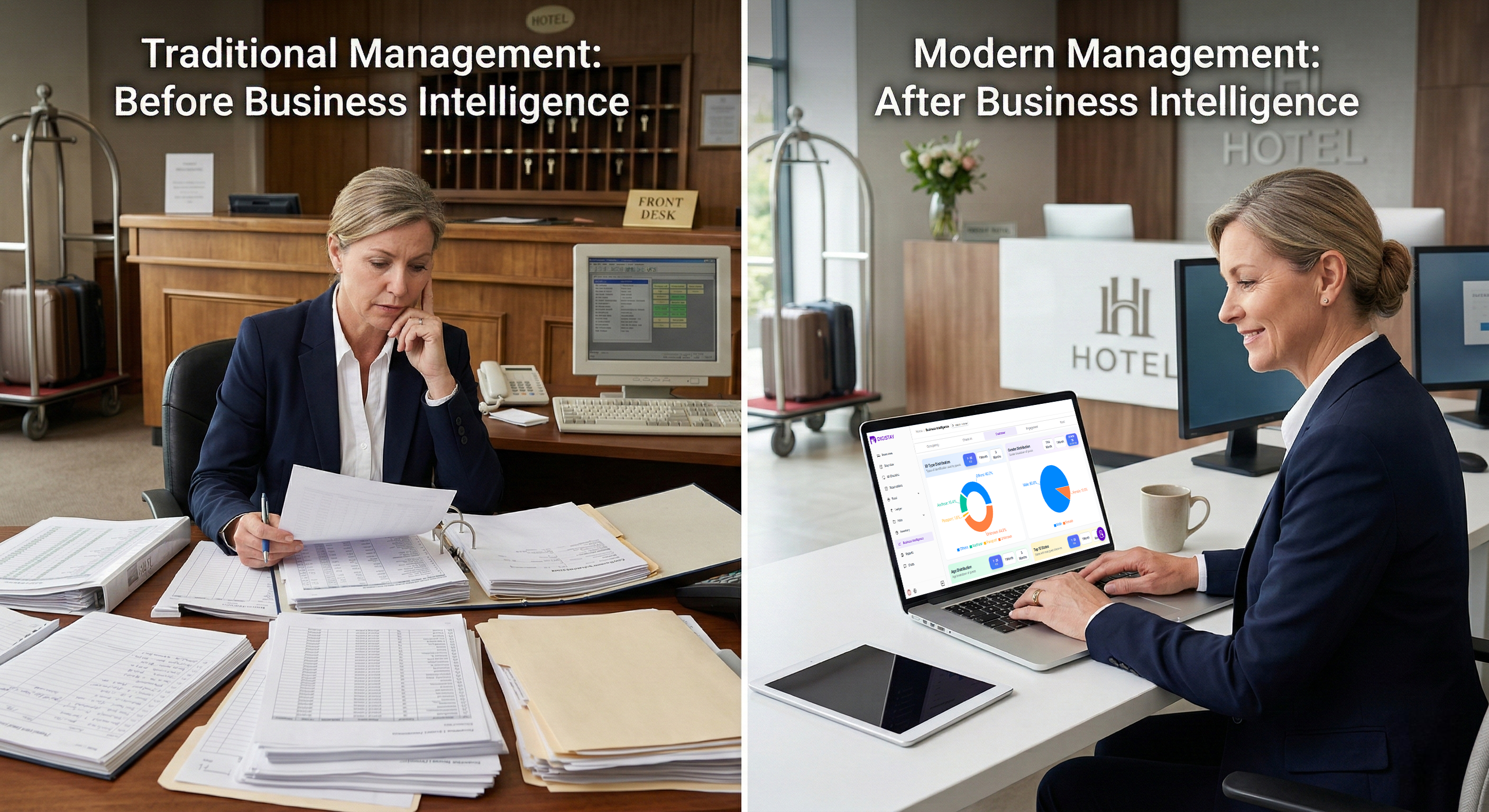
Hotels using business intelligence for hotels gain measurable advantages across three key areas.
1. Revenue Optimization
2. Operational Efficiency
3. Enhanced Guest Experience
These capabilities directly impact profitability and long-term competitiveness.
The Shift from Traditional to Data-Driven Hotel Management
| Traditional Hotel Management | BI-Driven Hotel Management |
|---|---|
| Manual reports | Real-time dashboards |
| Reactive decisions | Predictive insights |
| Fixed pricing | Dynamic pricing |
| Limited visibility | Integrated performance view |
Hotels that adopt hotel business intelligence software gain instant operational visibility and faster response to market changes. This transformation is especially visible in emerging hospitality markets such as India, where digital adoption is rapidly accelerating.
Key Features of the Best Hotel Business Intelligence Software
Choosing the best hotel business intelligence software requires evaluating three essential capabilities.
Data Integration
Advanced Analytics
Visualization & Reporting
These features ensure insights are accessible, actionable, and decision-ready.
Business Intelligence for Small and Mid-Size Hotels
Cloud technology has made hotel business intelligence software solutions accessible to independent and boutique properties.
Benefits for Smaller Hotels
Smaller hotels can start with revenue analytics and expand gradually into operations and guest experience management.
From Metrics to Strategy: The Real Value of Hotel BI

The true value of hotel industry business intelligence lies in turning data into strategy.
BI enables hotels to:
It shifts management from reactive reporting to proactive growth planning.
Common Misconceptions About Hotel Business Intelligence
| Misconception | Reality |
|---|---|
| “BI is only for large hotel chains.” | Modern cloud solutions serve properties of all sizes. |
| “BI requires technical expertise.” | Today’s platforms are designed for non-technical users. |
| “Standard reports are enough.” | Traditional reports lack predictive insights. |
| “Implementation is complex and disruptive.” | Phased deployment allows smooth adoption. |
The Cost of Not Using Hotel Business Intelligence
Hotels without BI often experience hidden losses:
Over time, data-driven hotels consistently outperform manual operations.
Building a Data-Driven Hotel Organization
Successful adoption of business intelligence for hotels requires more than software.
Hotels must ensure:
A unified data environment creates complete operational visibility.
How to Implement Hotel Business Intelligence?
A structured implementation process ensures success.
Measuring ROI from Hotel Business Intelligence

Turning guest data into growth, where insights meet action at the reception desk.
Short-Term Results
Long-Term Gains
Continuous monitoring ensures long-term value.
Conclusion: Future-Proofing Hotels with Business Intelligence
Hotel business intelligence has become the foundation of modern hotel management. It enables smarter decisions, optimized revenue strategies, and enhanced guest experiences. Hotels that implement hotel business intelligence software solutions gain real-time visibility, operational efficiency, and long-term resilience. Investing in data-driven decision-making today ensures stronger performance tomorrow.

About the Author
Content & Copywriting Professional
Vidushi is a content and copywriting professional specializing in SEO-driven websites, blogs, and social media content. She works across content strategy, structure, and optimization, ensuring ideas are not just well-written but effectively executed collaborating closely with designers and developers from concept to deployment.
“Good content communicates. Great content performs.”
Frequently Asked Questions
Software that collects and analyzes hotel data from multiple systems to support data-driven decision-making.
By enabling dynamic pricing, accurate forecasting, and demand analysis.
Yes. Cloud-based solutions make BI scalable and affordable for smaller properties.
Through revenue growth, cost savings, operational efficiency, and long-term strategic improvement.
With proper planning and phased rollout, implementation is straightforward and highly beneficial.